

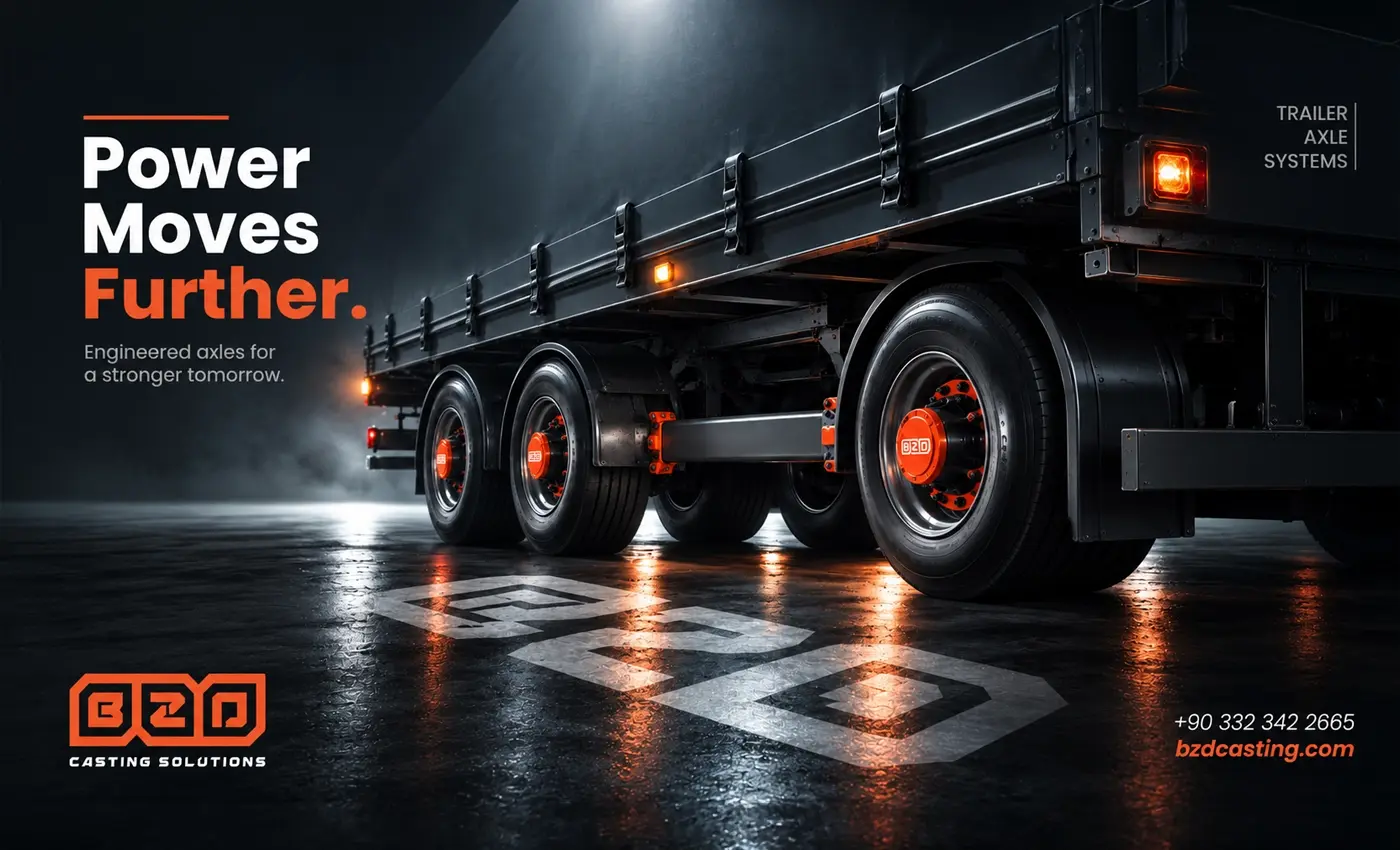
What Are Trailer Parts? Types and Applications
Trailer spare parts consist of mechanical components that support the safe, stable, and efficient operation of agricultural trailers and various load-carrying equipment. Axle systems, hubs, brake drums, leaf springs, landing gear, and connecting components play an essential role in enabling trailers to perform their various functions.
Trailers used in the agricultural and transportation industries may be subjected to different loads and mechanical stresses depending on their operating conditions. Therefore, selecting the right trailer parts is essential to ensuring that the equipment operates in accordance with its technical requirements.
When choosing trailer spare parts, it is important to consider not only the product's name or appearance but also its dimensions, load capacity, connection specifications, and intended application.
What Are Trailer Spare Parts Used For?
Trailer spare parts are components responsible for essential functions such as load carrying, movement, braking, connection, and support.
Each component performs a specific function within the trailer system.
For example, axle systems help transfer loads to the wheels, while hubs enable the wheels to rotate smoothly. Brake drums are essential components of compatible braking systems.
Leaf spring systems contribute to suspension performance, while landing gear supports trailers in specific positions.
The compatibility and proper operation of these components are essential to the overall performance of a trailer.
What Is a Trailer Axle?
A trailer axle is one of the main mechanical components that supports the trailer's wheels and transfers loads to them.
Trailer axles can be manufactured with different specifications depending on the trailer's design and operating conditions.
Common trailer axle types include braked and unbraked axles.
Braked Trailer Axle
A braked axle is a type of trailer axle designed to operate with a compatible braking system.
It is used in trailer applications that require braking capabilities.
When selecting a braked axle, both its load capacity and the compatibility of its braking system with the towing vehicle must be evaluated.
Unbraked Trailer Axle
An unbraked axle is an axle system without an independent braking mechanism.
It can be used in trailer applications where technical specifications and legal regulations permit.
When selecting an unbraked axle, the trailer's total weight and operating conditions must be considered.
What Is a Trailer Hub?
A trailer hub is a mechanical component to which the wheel is attached, allowing it to rotate through a suitable bearing system.
The hub is an important component for the proper operation of the wheel assembly.
Trailer hubs may vary in dimensions and mounting specifications.
Therefore, when selecting a hub, axle compatibility, bearing specifications, and wheel mounting dimensions must be evaluated.
What Is the Function of an Assembled Hub?
An assembled hub refers to a hub assembly consisting of several components.
The components included in the assembly may vary depending on the model and manufacturer.
When selecting an assembled hub, dimensional and mechanical compatibility with the existing axle system must be verified.
What Is a Trailer Brake Drum?
A trailer brake drum is an essential braking component used in drum brake systems.
During braking, it works together with suitable friction components to help slow down the wheel.
The proper operation of the brake drum depends on the overall condition of the braking system.
When selecting a brake drum, its diameter, width, mounting dimensions, and compatibility with other braking components must be considered.
What Is an Assembled Brake Drum?
An assembled brake drum refers to a brake drum assembly prepared with specific components.
The technical specifications and included components may vary depending on the model.
Before purchasing an assembled brake drum, compatibility with the axle and braking system must be verified.
What Is a Trailer Leaf Spring?
A trailer leaf spring is a mechanical component used in suitable suspension systems to help absorb and withstand forces generated by loads.
Leaf spring systems can be used in different configurations depending on the trailer's design.
These components contribute to the operation of the suspension system during load transportation.
What Is a Parabolic Leaf Spring?
A parabolic leaf spring is a type of leaf spring designed with a specific thickness distribution along its length.
Parabolic leaf springs help regulate the flexibility and suspension characteristics of appropriately designed systems.
The specifications of parabolic leaf springs may vary depending on the material, number of leaves, dimensions, and design load.
Therefore, parabolic leaf springs should not be selected based solely on their external appearance.
What Is Trailer Landing Gear?
Trailer landing gear is equipment designed to support a trailer or help adjust its height under specific operating conditions.
Support is particularly important when a trailer is disconnected from the towing vehicle.
Landing gear systems may vary in load capacity and operating mechanisms.
Geared Landing Gear
Geared landing gear is a type of support equipment that uses a gear mechanism to raise or lower a trailer.
These products may have different load capacities depending on their design specifications.
When selecting landing gear, the load to be supported, mounting position, and operating conditions must be evaluated.
Landing gear should not be used as the sole means of supporting a load while people are working underneath it unless the manufacturer explicitly permits such use.
What Is a Trailer Drawbar Eye?
A trailer drawbar eye is an important component of the towing connection system that connects a trailer to the towing vehicle.
Drawbar eye systems may have different dimensions and connection specifications depending on the trailer design.
Selecting the correct drawbar eye is essential for ensuring mechanical compatibility between the towing vehicle and the trailer.
Mounting dimensions, permissible loads, and operating conditions must be considered.
Using incompatible connection components can lead to serious safety risks during transportation.
What Are Trailer Connecting Components?
Trailer connecting components are used to securely assemble different mechanical parts of a trailer.
These components may include wheel bolts, nuts, pins, and various fastening elements.
The technical specifications of connecting components vary depending on their intended application.
Correct dimensions, materials, and installation methods are particularly important for connections involving load-bearing or moving components.
Using incorrect fasteners may result in mechanical loosening or component damage.
What Are Agricultural Trailer Spare Parts?
Agricultural trailers are equipment used to transport agricultural products and various materials.
These trailers may contain numerous mechanical components, including axles, hubs, brake drums, leaf springs, landing gear, and connecting parts.
The types and quantities of components used depend on the trailer's design.
When selecting agricultural trailer spare parts, operating terrain, load capacity, and frequency of use must be considered.
Regular maintenance and inspection are particularly important under demanding operating conditions.
What Should You Consider When Choosing Trailer Spare Parts?
When purchasing trailer spare parts, it is essential to carefully examine the technical specifications of each product.
1. Product Compatibility
The selected component must be compatible with the existing trailer system.
Products should not be selected solely based on visual similarities without verifying dimensions and mounting specifications.
2. Load Capacity
The load capacities of load-bearing components must meet the trailer's design requirements.
This is particularly important for axle, leaf spring, and connection systems.
3. Material and Manufacturing Specifications
The manufacturing process and materials used can influence a component's technical performance.
However, a particular material or manufacturing method does not necessarily provide superior performance in every application.
4. Operating Conditions
Trailers used in agricultural fields, industrial facilities, or different transportation environments may have varying requirements.
Therefore, spare parts must be selected according to actual operating conditions.
5. Technical Documentation
Product dimensions, mounting specifications, and load capacity information should be verified through technical documentation whenever possible.
This approach helps reduce the risk of selecting incompatible components.
Why Is Trailer Spare Parts Maintenance Important?
Regular trailer inspections can help identify mechanical problems at an early stage.
Axles, hubs, bearings, braking components, and fasteners should be inspected at appropriate intervals.
During maintenance, signs of wear, loosening, cracks, unusual noises, and excessive heating should be evaluated.
Maintenance and component replacement procedures must be performed according to the manufacturer's technical instructions.
BZD Casting Trailer Spare Parts
BZD Casting Solutions offers a product portfolio featuring various components for the trailer and agricultural equipment industries.
Braked and unbraked axles, assembled hubs, brake drums, leaf spring systems, and various trailer components are among the product categories available in its portfolio.
For trailer manufacturers, agricultural equipment producers, and spare parts suppliers, selecting the right products requires a careful evaluation of technical requirements.
By exploring BZD Casting's product categories, you can learn more about different trailer components and evaluate suitable options for your specific needs.
Frequently asked questions
Römork yedek parçaları nelerdir?
Römork yedek parçaları arasında dingiller, poryalar, kampanalar, makaslar, krikolar ve bağlantı elemanları bulunur.
Römork dingili ne işe yarar?
Römork dingili, yükün tekerleklere aktarılmasına ve tekerleklerin uygun konumda çalışmasına yardımcı olur.
Römork poryası nedir?
Porya, tekerleğin bağlandığı ve rulman sistemi aracılığıyla dönmesini sağlayan parçadır.
Römork kampanası ne işe yarar?
Kampana, uygun kampanalı fren sistemlerinde frenleme işleminin gerçekleştirilmesine katkıda bulunur
Parabolik makas nedir?
Parabolik makas, yapraklarının kalınlık dağılımı özel olarak tasarlanmış bir süspansiyon bileşenidir.
Römork krikosu ne işe yarar?
Römork krikosu, uygun kullanım koşullarında römorkun desteklenmesine veya yüksekliğinin ayarlanmasına yardımcı olur.
Römork okbaşı nedir?
Okbaşı, römorkun çekici araçla bağlantısını sağlayan çekme düzeninin bir bileşenidir.
Römork yedek parçası seçerken nelere dikkat edilmeli?
Ürün ölçüleri, taşıma kapasitesi, bağlantı özellikleri ve mevcut sistemle uyumluluk değerlendirilmelidir.
Tarım römorklarında hangi yedek parçalar kullanılır?
Tarım römorklarında dingil, porya, kampana, makas, kriko ve farklı bağlantı parçaları kullanılabilir. Parçalar römorkun tasarımına göre değişir.
Römork yedek parçaları nereden temin edilir?
Römork yedek parçaları ilgili üretici ve tedarikçilerden temin edilebilir. BZD Casting Solutions'ın ürün portföyü de farklı parça seçeneklerini incelemek için değerlendirilebilir.
